How to Leverage Customer Reviews to Get Recommended by AI
Leveraging Customer Reviews to Get Recommended by AI
The short and sweet version(TL;DR):
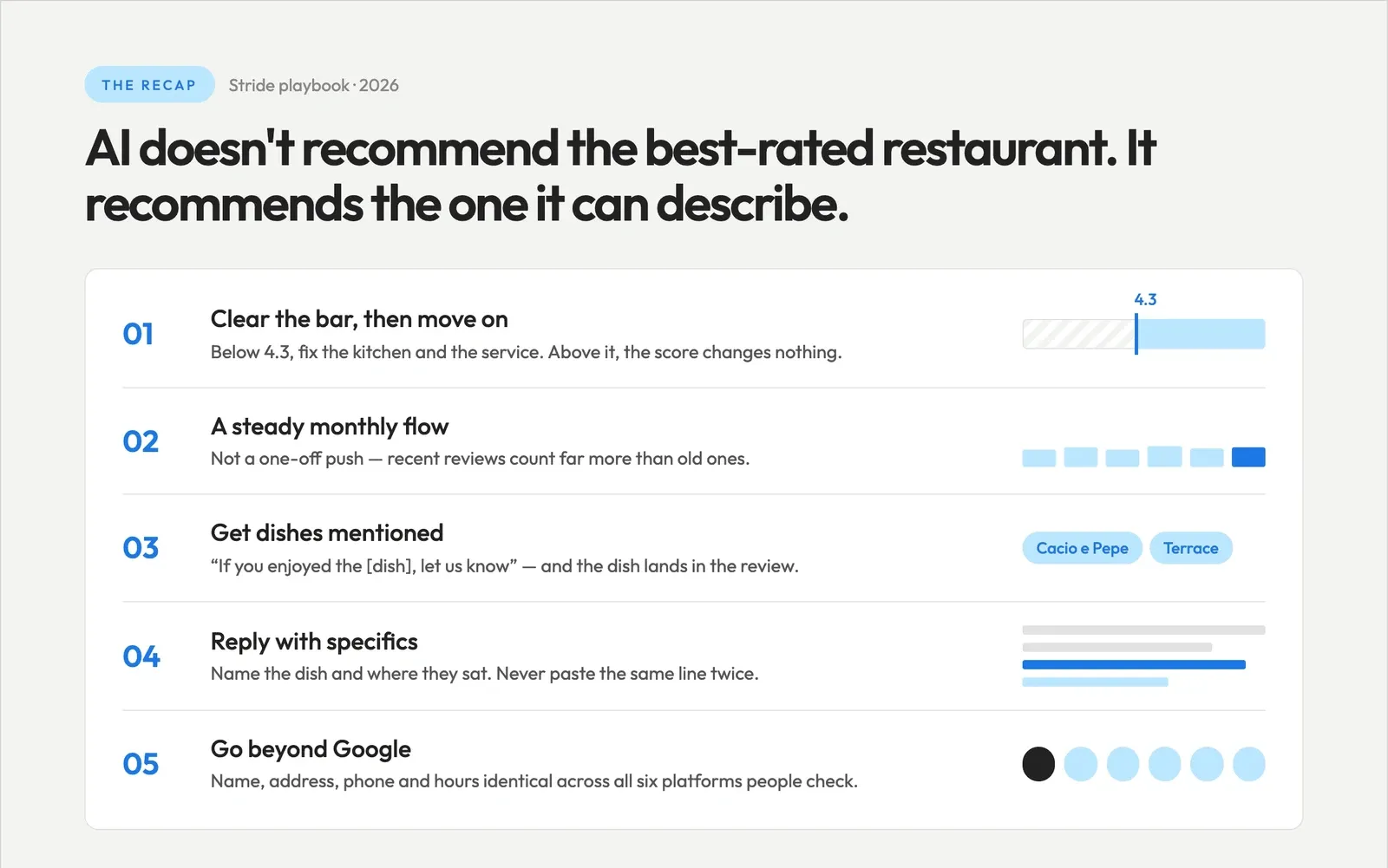
AI does not recommend the highest-rated restaurant. It recommends the one it can describe. Rating gets you considered. Recent, specific reviews that name dishes and occasions get you recommended. Here are five levers that truly help:
-
Clear the rating bar, then move on - If your Google rating is below about 4.3, fix the food and service first. If it is already above, stop worrying about the score.
-
Aim for a steady monthly flow of reviews, not a one-off push - Recent reviews count far more than old ones.
-
Get dishes named - Train staff to say “if you enjoyed the [dish], let us know”, so reviews mention specifics an AI can use.
-
Reply with specifics - Name the dish and the spot in your responses, and never paste the same one twice.
-
Go beyond Google - Keep your name, address, phone, and hours identical everywhere, so you are easy to describe across sources.
Bottom line: every one of these relies on reviews you do not own. Your own restaurant website is the one place your restaurant stays findable on your terms.
The longer, more detailed version:
AI doesn’t recommend based on the most stars. They recommend based on what they are able to say and stand by. That means passing a baseline rating and then having recent, detailed, specific reviews that name dishes and events.
Rating to be considered.
Reviews to be recommended.
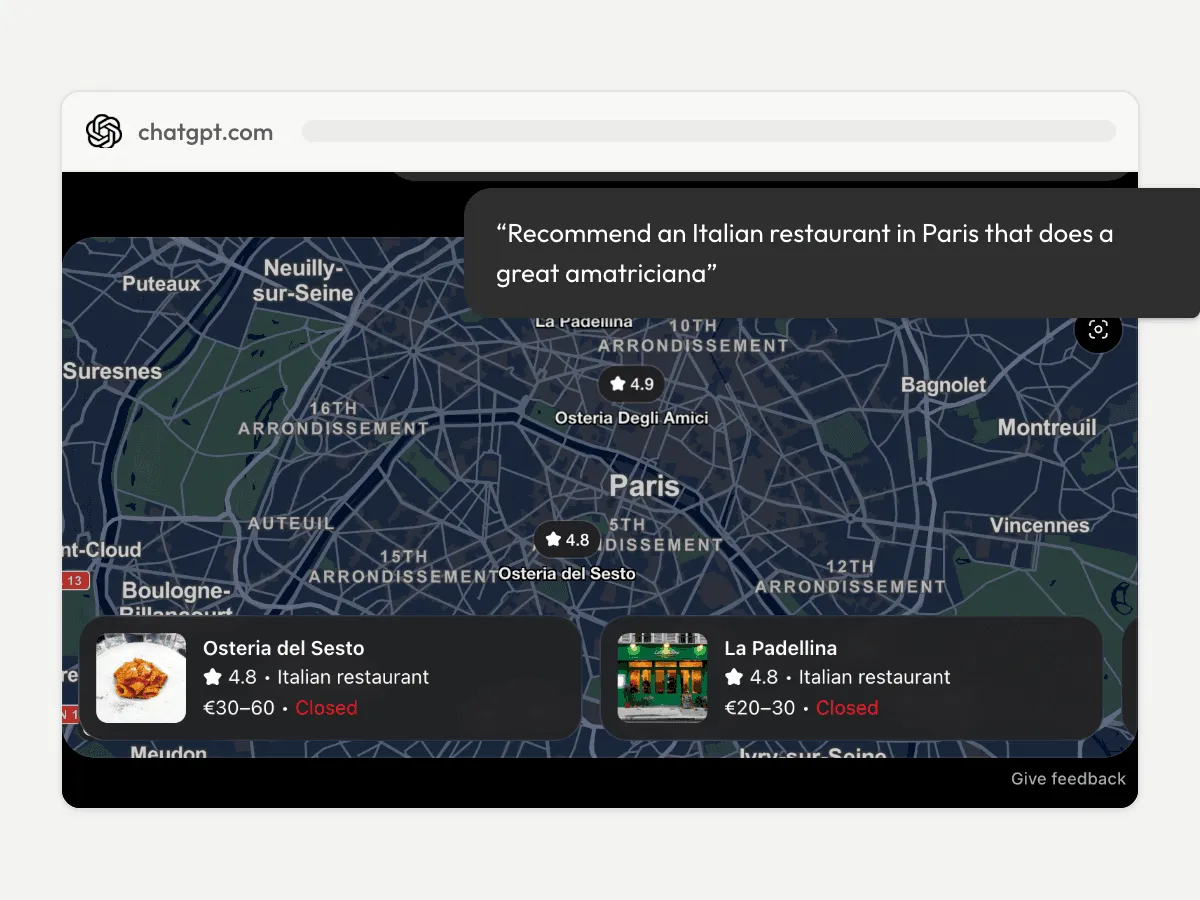
You’re sitting pretty at 4.8. The place just around the corner is at 4.3. When someone asks ChatGPT where to eat nearby, your neighbour’s restaurant gets the call.
Not an exception, not an injustice, a process.
And here’s how you work it.
Your Rating Doesn’t Work As Hard As You’ve Been Told
You probably know how much Google Star ratings matter. Many don’t know what ChatGPT Star ratings do.
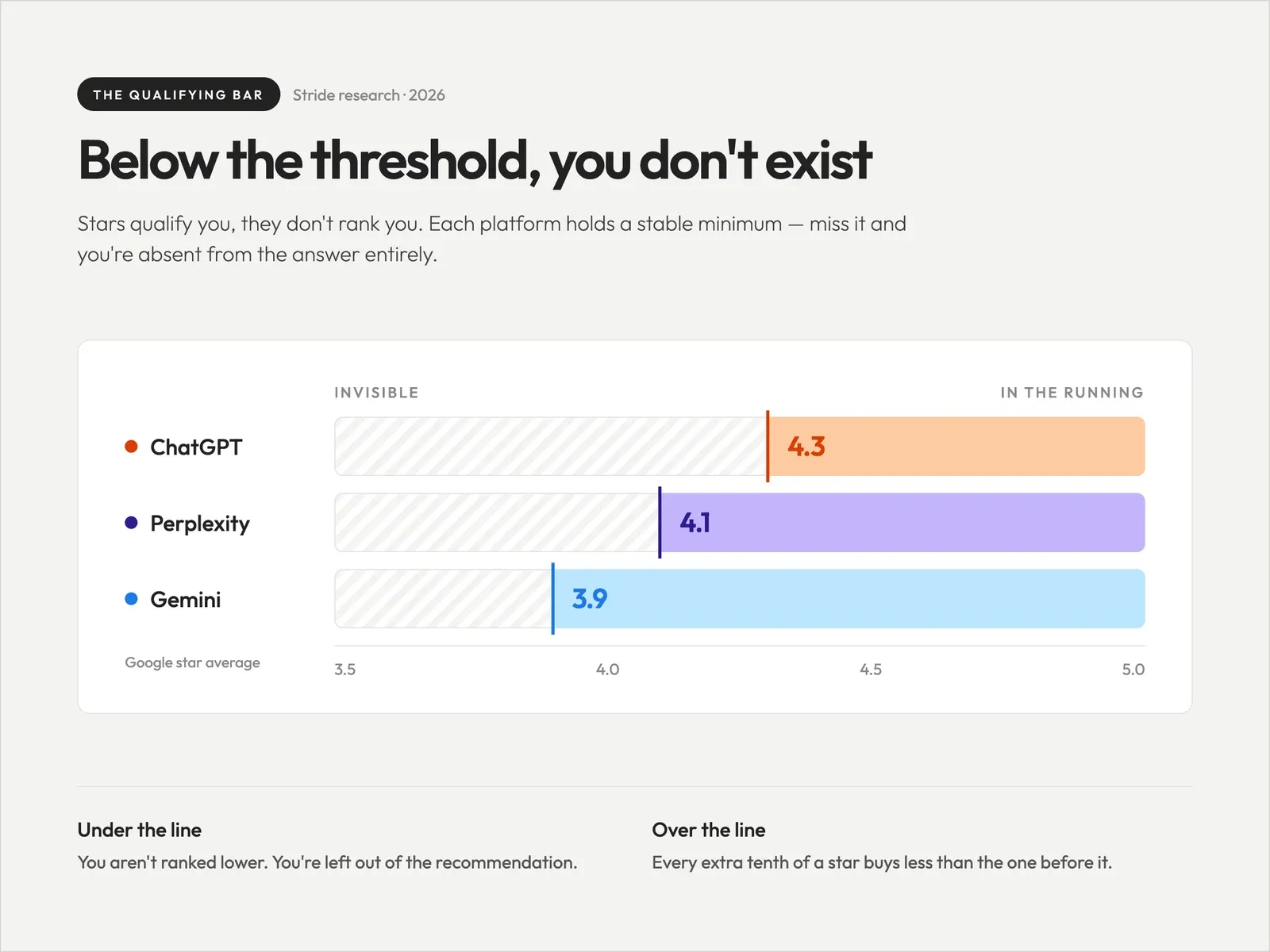
The simple answer is that star ratings do one thing and one thing only: qualify you. There is a minimum quality of ratings necessary to be considered. Once passed, it’s a linear increase for most platforms.
In fact, our own research showed a stable minimum threshold for AIs, hovering around 4.3 stars for ChatGPT, 4.1 for Perplexity, and 3.9 for Gemini.
If your star average falls below that, your restaurant won’t appear at all. If it’s higher than the threshold, the impact on recommendations diminishes with each tenth of a star. The true game changers lie elsewhere.
A study released in February 2026 by MyPlace looked at 230 restaurants in 5 US markets responding to 80 different recommendation prompts.
Restaurants recommended by AI had average Google review volumes of 3,424 to restaurants not recommended, with an average volume of 955 – a 3.6-fold difference!
The star rating gap between these two groups was nearly non-existent (0.03 stars).
Consider this case: a James Beard winner in Austin with a 4.7-star rating and just 908 reviews was unseen on all four tested AI platforms. In Seattle, a highly rated 4.4 Star place with more than 5,000 reviews made recommendations across all four!
Your neighbour, with a 4.3, isn’t recommended simply because they have a “better” selection, but because there’s simply MORE to say about them.
It’s All About the Description
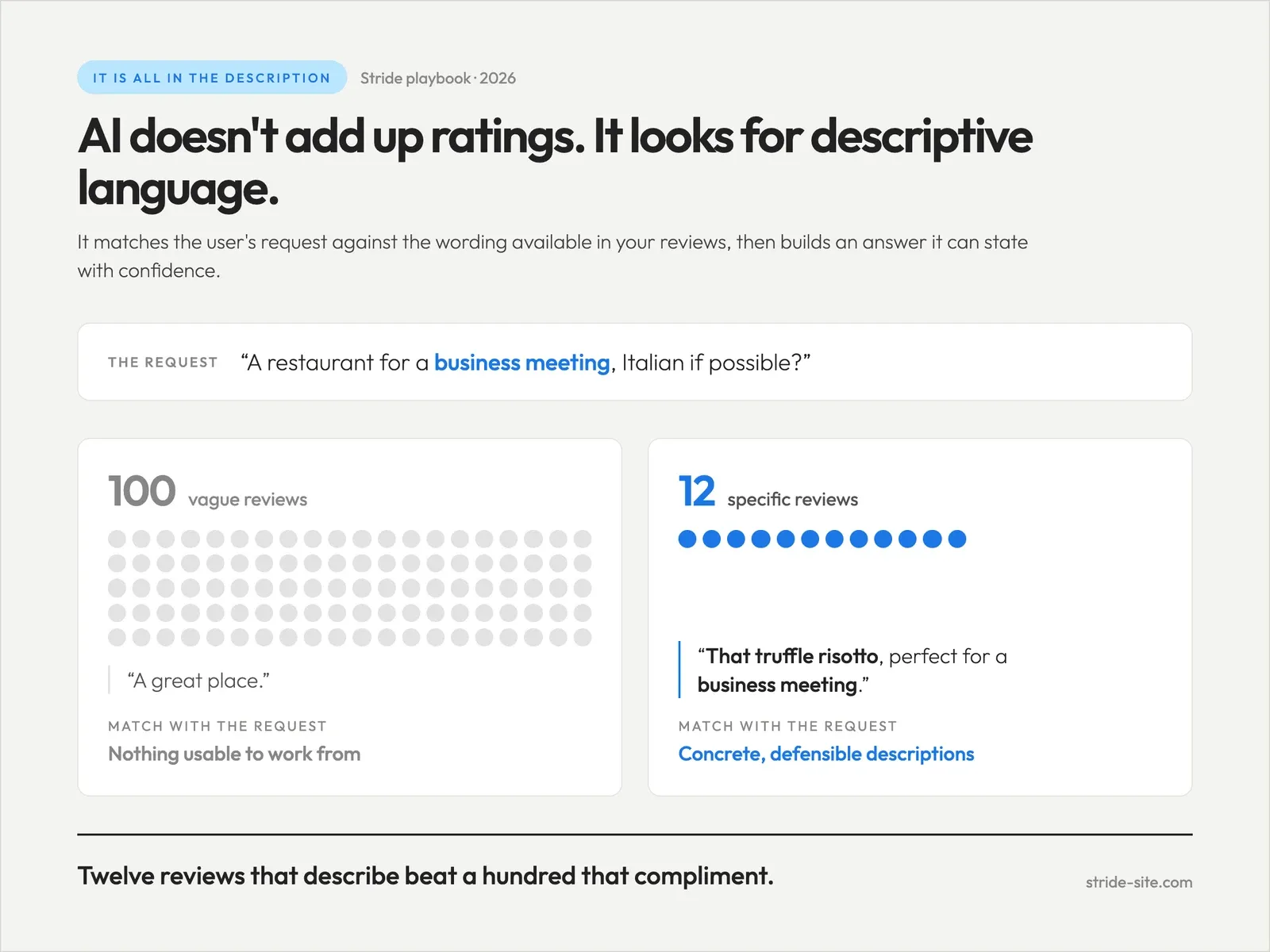
An AI seeking to make a restaurant recommendation doesn’t merely aggregate ratings and call it a day. It searches the user’s input against the descriptive language available in reviews to construct a response it can confidently “stand by”.
When a hundred reviews mention “a great place,” an AI gains no actionable intelligence to satisfy specific user requests.
Twelve reviews specifically mention “that truffle risotto dish” or a “business meeting,” providing tangible, defensible descriptions.
Why are the questions we’re asking increasingly specific, though?
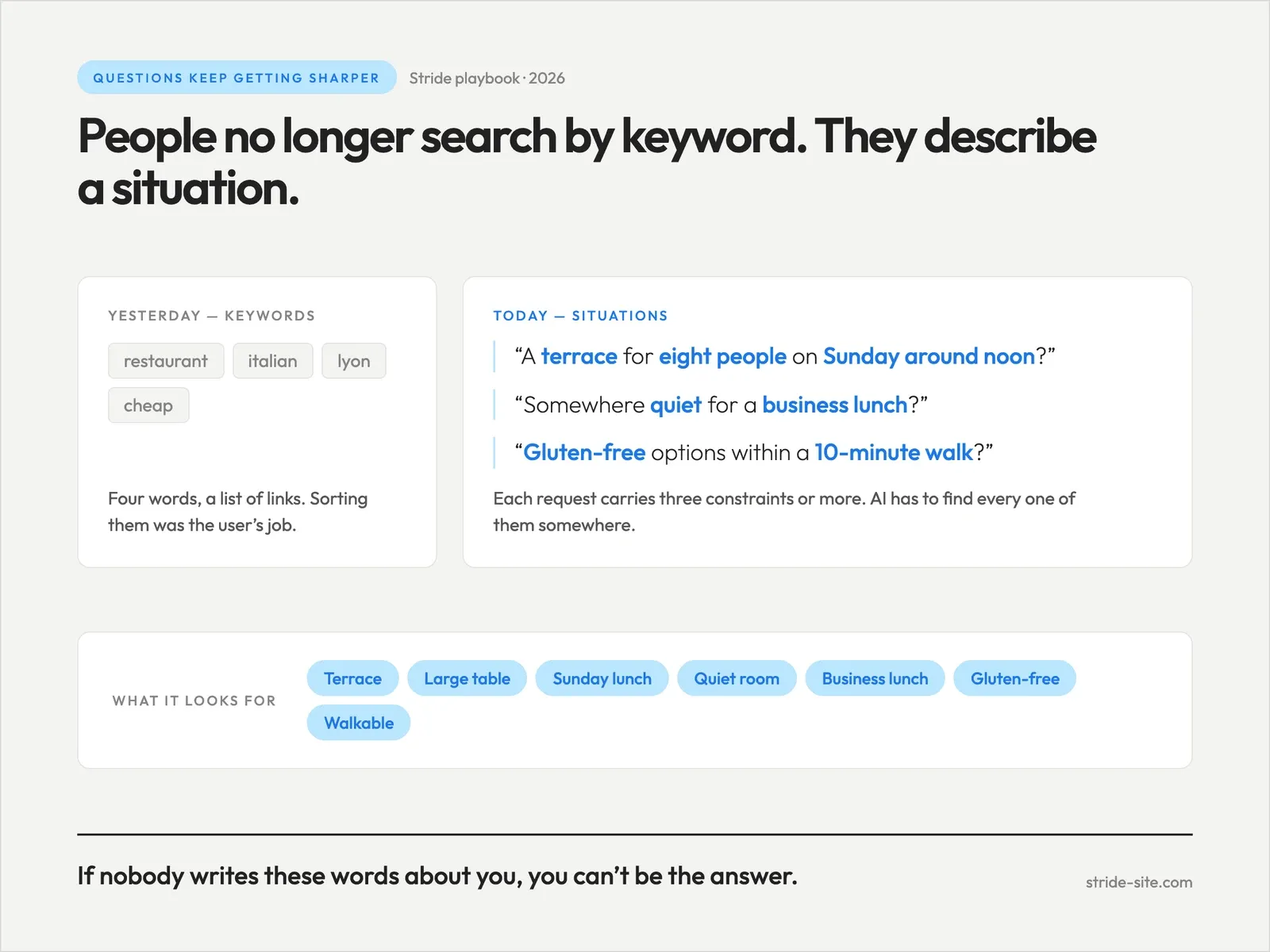
Because the way people query AI is evolving beyond simple keywords. They are asking based on situations:
-
“A terrace for eight people on Sunday around noon?”
-
“A quiet place for a business lunch?”
-
“Gluten-free options within a 10-minute walk?”
Your Restaurant’s Place on the AI Recommendation Board
1. Qualify for Consideration, then Get it Out of Your Head First
If you’re below 4.3 stars on Google, focus all efforts on the kitchen and service floor.
Online efforts won’t make the difference.
If you’re over a 4.4, resist the urge to micromanage. Gaining another tenth of a star requires immense effort for a minimal payoff.
Recognise that it’s a binary, so either you’re in, or you’re not; let that inform your strategy from here.
2. Shift from Campaigns to a Sustainable Pace
This step is paramount for established restaurants. The impact of recent reviews far outweighs historical ones.
BrightLocal’s 2026 study showed that 74% of U.S. Consumers prioritize reviews from the past three months over older ones.
Accumulating hundreds of older reviews is like having money in a bank that’s gradually losing value.
A burst of reviews followed by a long silence is less effective than a consistent trickle.
Don’t chase a high cumulative count; focus instead on your monthly rate.
Benchmark by assessing the three highest-ranking restaurants on popular AI platforms and note their monthly review volume.
This is your target.
3. Encourage Dish Mentions
This is the easiest win with the biggest impact for free, requiring no change in volume or process, only phrasing.
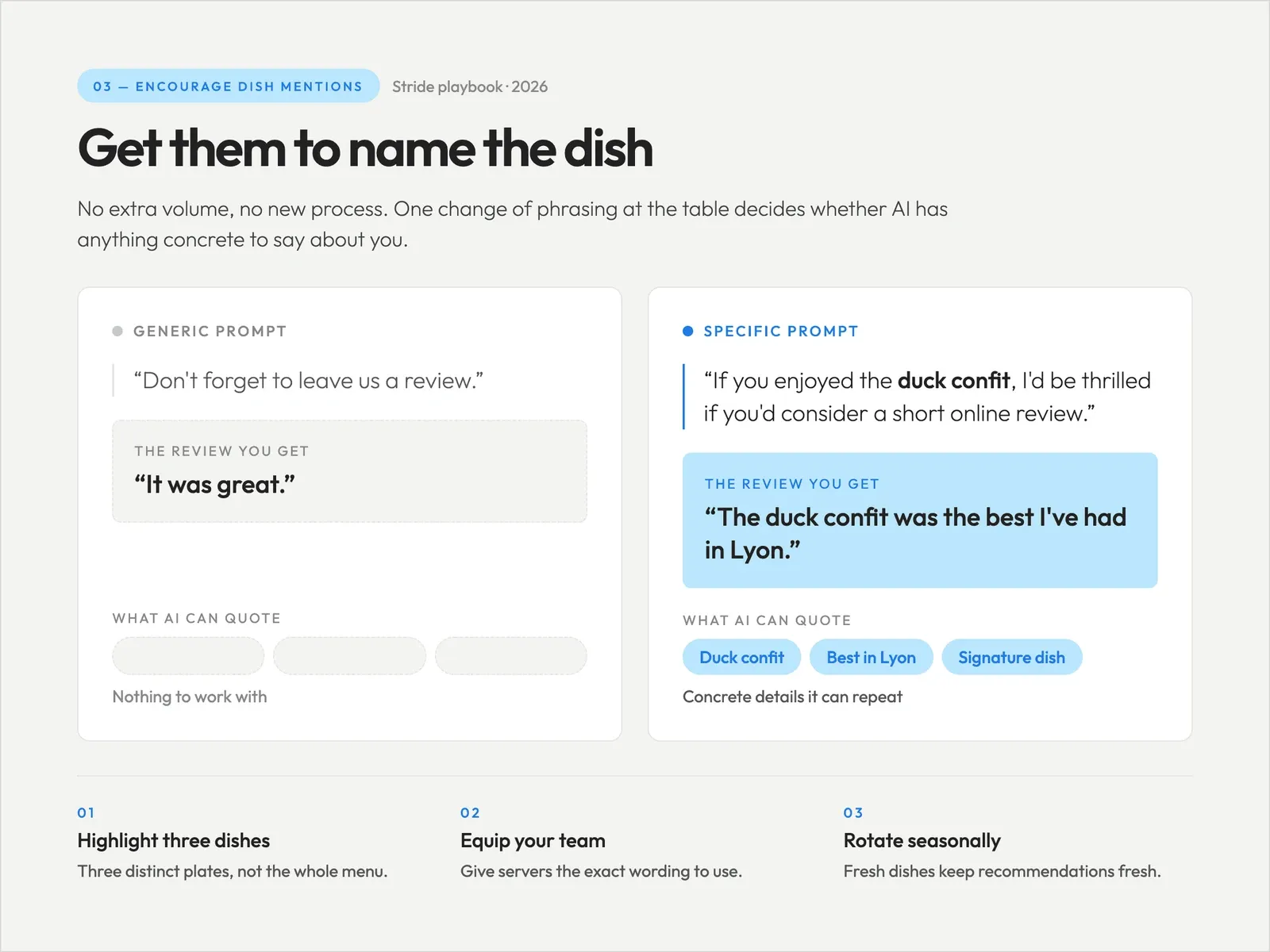
A generic prompt from your server will lead to “It was great,” as you’d expect.
However, if a server prompts:
“If you enjoyed the [dish you want to highlight], I’d be thrilled if you’d consider a short online review,”
you empower customers to name specific menu items.
Such mentions provide the AI with concrete details it can use to describe your restaurant.
Highlight three distinct dishes, equip your team with specific wording, and rotate those dishes seasonally to keep recommendations fresh.
4. Respond with Specificity
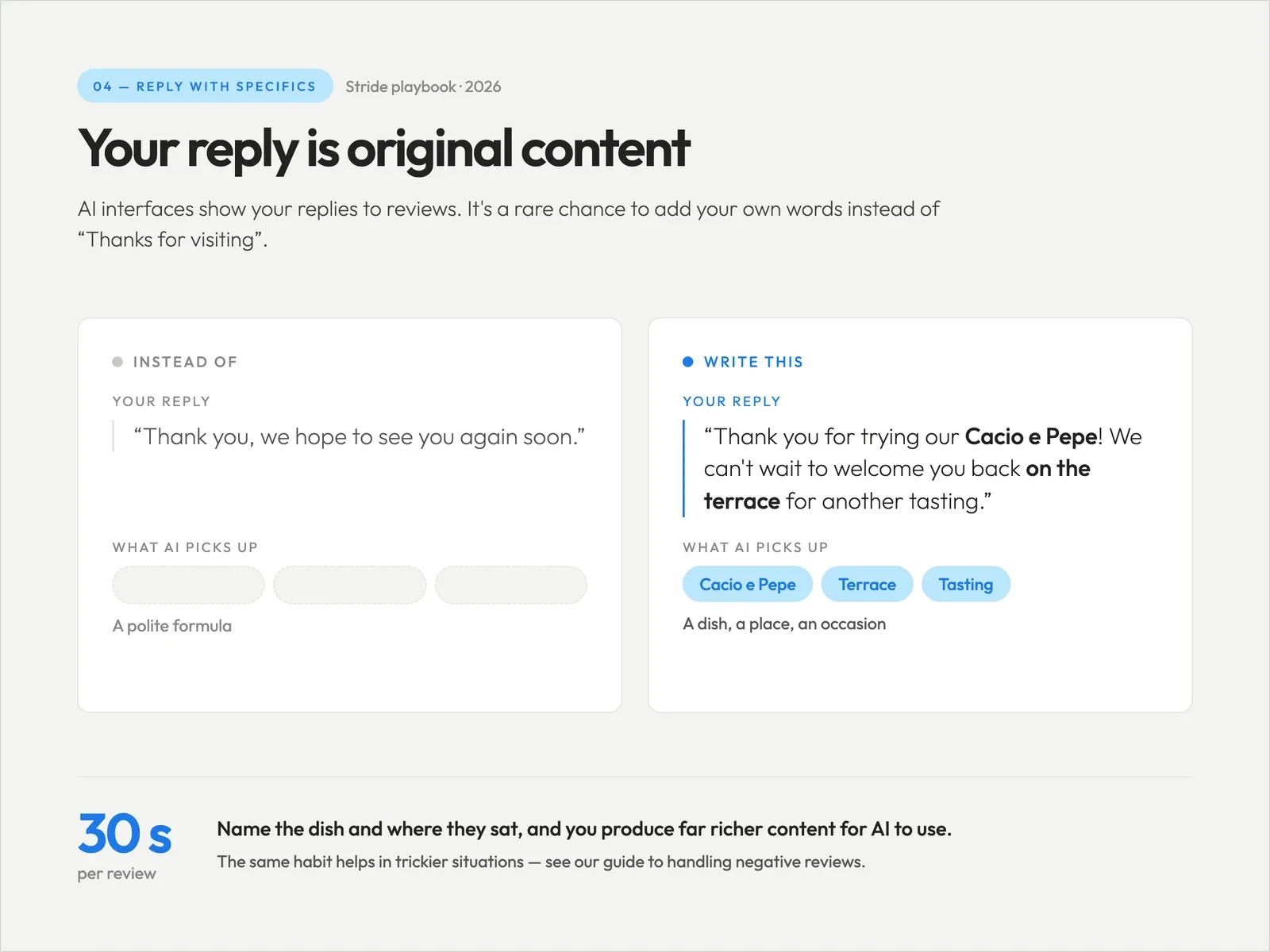
AI interfaces display responses on reviews, and they’re a rare opportunity for you to add original text beyond a perfunctory “Thank you for visiting!”
Instead of:
“Thanks, we hope you visit again soon,”
write:
“Thank you for experiencing our Cacio e Pepe! We look forward to seeing you back on the patio for another taste.”
A simple thirty seconds per review, naming the specific dish and table location, will create richer text the AI can draw from.
This also forms good habits that help in challenging situations, so see our guide on responding to negative reviews for guidance.
5. Go Beyond Google
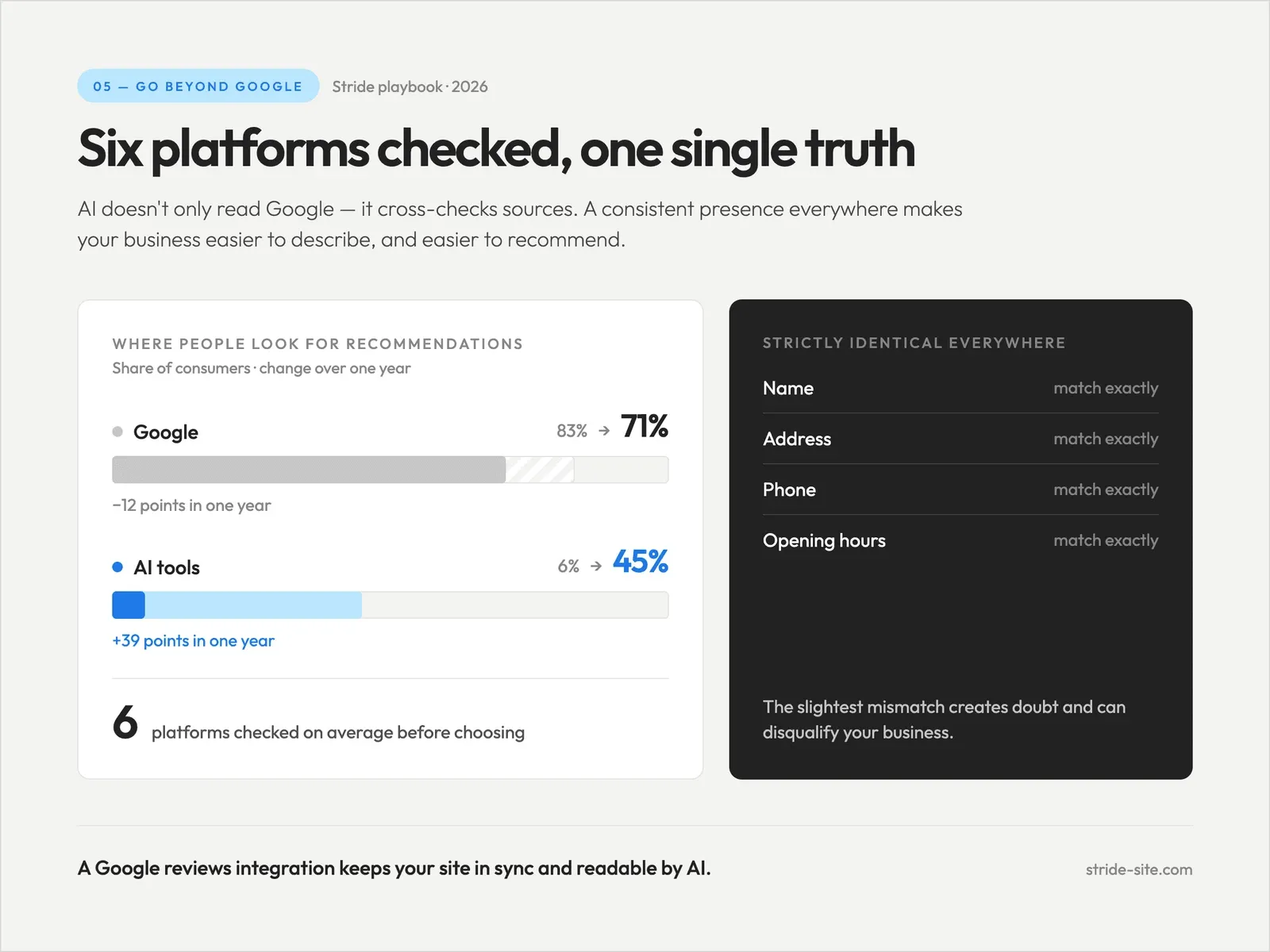
The average consumer now consults six platforms when seeking recommendations.
In just one year, Google’s share decreased from 83% to 71%, while AI tools gained substantial ground from 6% to 45%.
An AI won’t just look at Google; it will cross-reference information across multiple sources.
A consistent presence across platforms means your business is more easily described, making it more likely to be recommended.
Ensure your name, address, phone number, and hours of operation are identical everywhere.
Any discrepancy can create doubt and disqualify your establishment.
A Google Reviews integration keeps your site in sync and accessible for AIs too.
2 Quick Caveats and an Important Observation
These findings primarily represent the US market, so specific thresholds and volumes may differ for European locations.
However, the core mechanism remains: a minimum rating, ranking by review volume, emphasis on recency, and a preference for specific details.
This is the underlying principle driving many restaurants’ invisibility to ChatGPT, among others.
One somewhat discomforting observation is that these five strategies depend entirely on user reviews that reside on platforms beyond your control, subject to change and potential disappearance.
This underscores the critical importance of a robust, independently managed restaurant website that clearly outlines your offerings, location, and purpose-your enduring digital foundation.
Frequently Asked Questions
How many reviews do I need for AI to recommend my restaurant?
There's no magic number. For AI, a rapid pace of recent reviews is far more crucial than a high total once you've met the initial star threshold. Try to match or exceed the recent review generation of competitors that outrank you in search results.
Is my star rating still relevant?
Yes, but primarily as a gatekeeper. Once you exceed the threshold, while rating is important, its influence decreases, and review volume and specificity take over.