What Is a Website Care Plan?
What a website care plan includes, what is only padding, and how to tell whether your business needs one or a managed website instead.
 Pablo

What Is a Website Care Plan?
A website care plan is a monthly subscription that keeps a live website working after launch. It usually covers hosting, software and security updates, backups, uptime monitoring and a set amount of content changes or support each month. You pay a provider so that these jobs get done without you having to think about them.
The reason it exists is simple: a website is not finished on the day it goes live. If your business depends on it for bookings or enquiries, someone has to look after it. The real question is whether you buy that care as a separate plan, or choose a managed website where it is already included.
What Is the Difference Between Building a Website and Caring for It?
Building a website is a one-time project. Caring for it is the ongoing work that keeps it online, secure and correct. Think of buying a van: the purchase gets you the vehicle, while servicing and insurance keep it on the road. A care plan is the servicing part.
The same service is sold under several names: website maintenance plan, website care package, managed website. The name tells you little. What counts is what the plan includes, because two plans at the same price can cover very different things.
Why Does a Website Need Care After Launch?
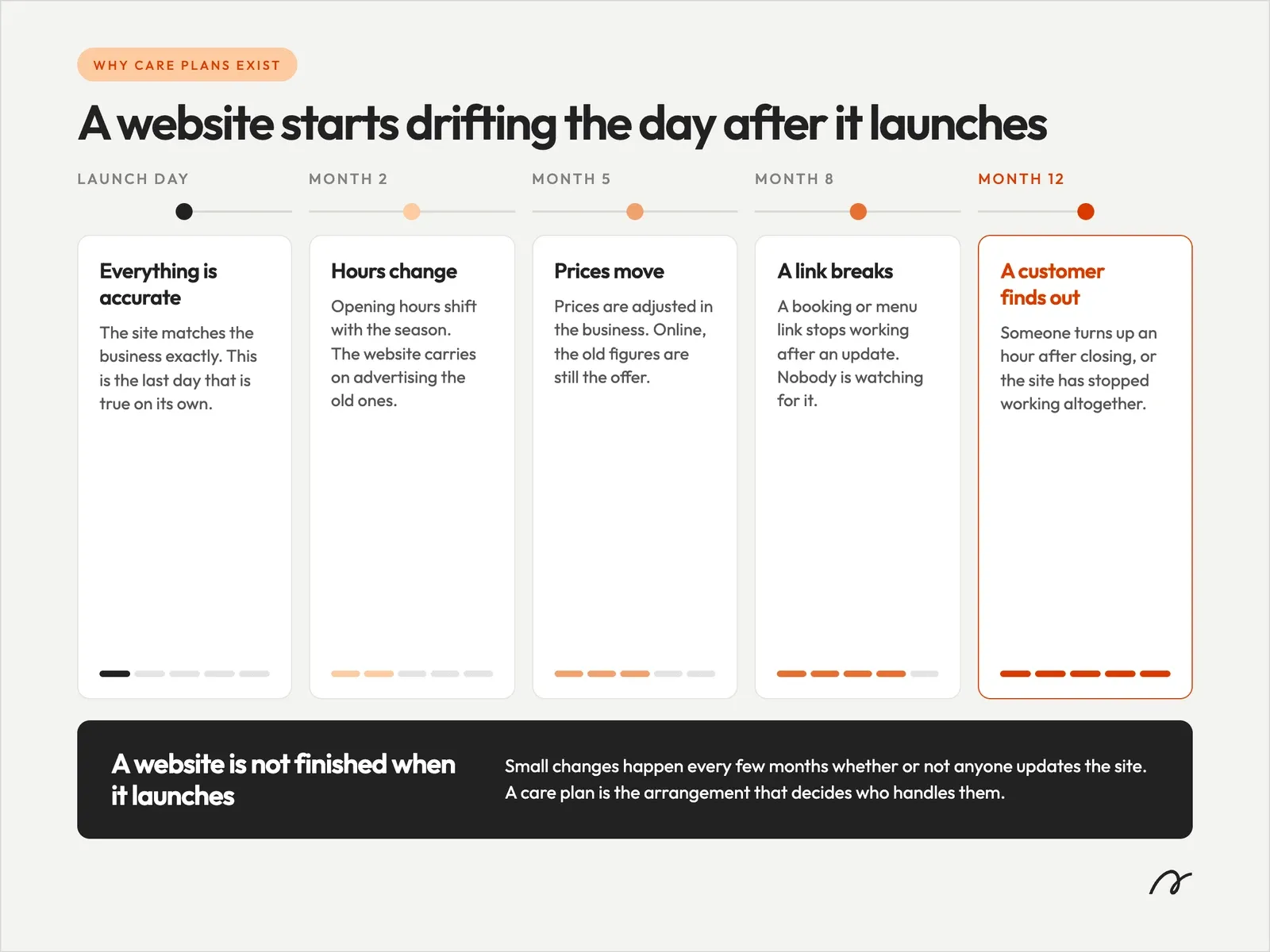
A website needs care because the business behind it keeps changing, and so does the software it runs on. Opening hours move, prices go up, a link breaks, a security update comes out. Each change is small, but a site nobody maintains is out of date within months.
Owners often find out from a customer: someone who came at the hours shown on the site and found the door closed, or who tried to book on a page that no longer worked. A care plan is there to deal with these quiet changes before a customer notices them.
What Does a Website Care Plan Include?
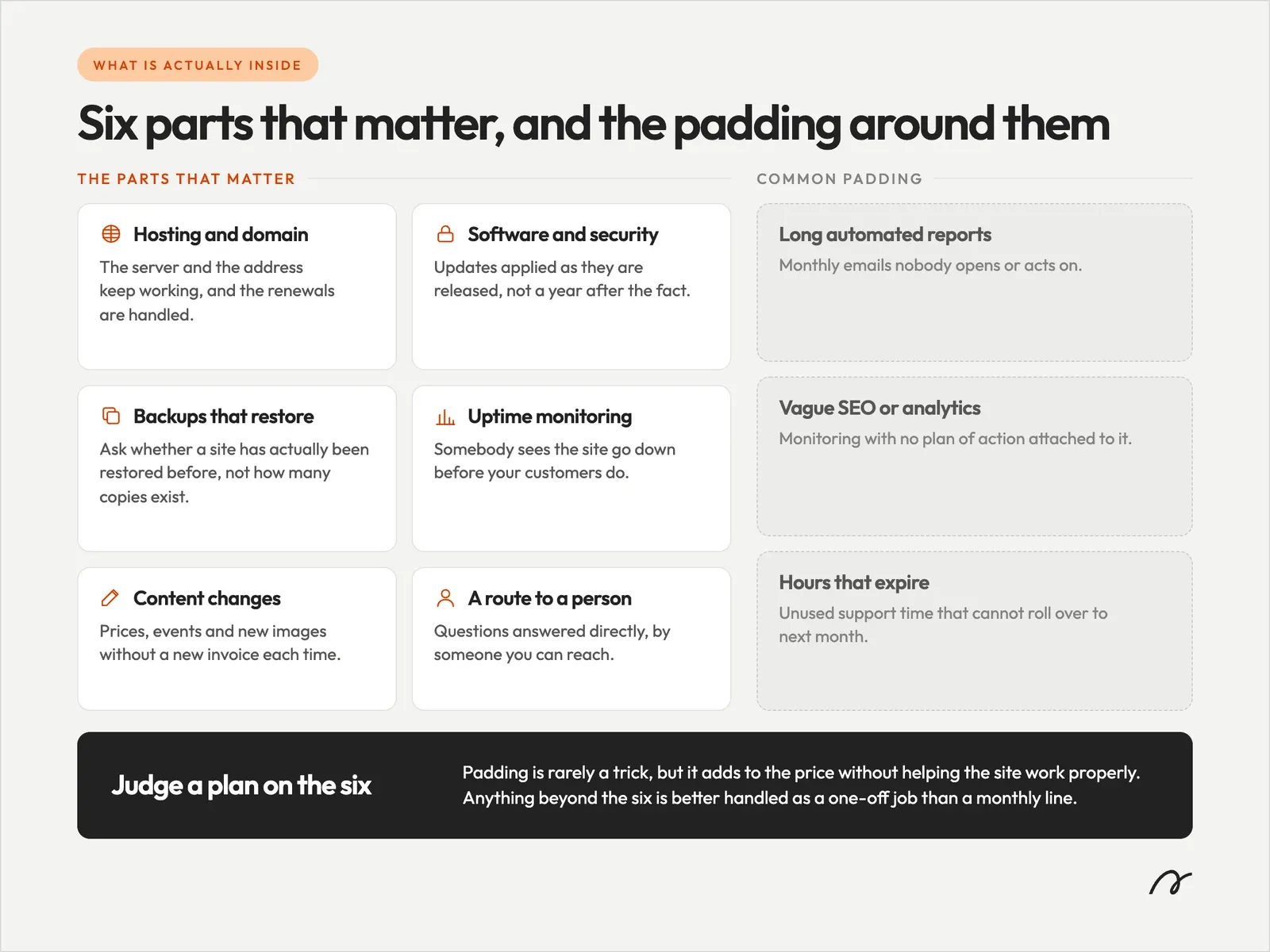
A good website care plan includes six things: hosting and domain, software and security updates, backups that can be restored, uptime monitoring, content changes, and a person you can reach. Anything beyond that is optional, and some of it is padding.
| Included | What it means for you |
|---|---|
| Hosting and domain | The server and your web address keep working and get renewed on time |
| Software and security updates | Updates are installed when they come out, not a year later |
| Backups that restore | A recent copy of your site exists, and the provider has restored one before |
| Uptime monitoring | Someone sees that the site is down before your customers do |
| Content changes | New prices, hours, events or photos without a separate invoice each time |
| A person to reach | A direct way to ask a question and get an answer quickly |
What Is Only Padding?
Some items make a plan look bigger without making your website work better:
- long automated reports nobody reads;
- vague “SEO monitoring” or analytics with no plan of action behind them;
- hours that expire each month and cannot be carried over.
Nobody is trying to cheat you with these, but they add to the price. Judge each plan on the six items above, and treat the rest as one-off work you can order when you need it.
Does My Business Need a Website Care Plan?
Your business needs a website care plan, or a managed website, as soon as the site takes bookings, payments, enquiries or sign-ups, or has information that changes. That covers almost every restaurant, clinic, professional practice and trade business.
You can go without one if:
- the site is a small, static page that hardly ever changes;
- you know how to maintain it yourself, and you actually do it;
- your business could live with the site being down for a few hours.
Not sure which case is yours? Start with whether your business needs a website at all, and what you expect from it.
Website Care Plan or Managed Website: What Is the Difference?
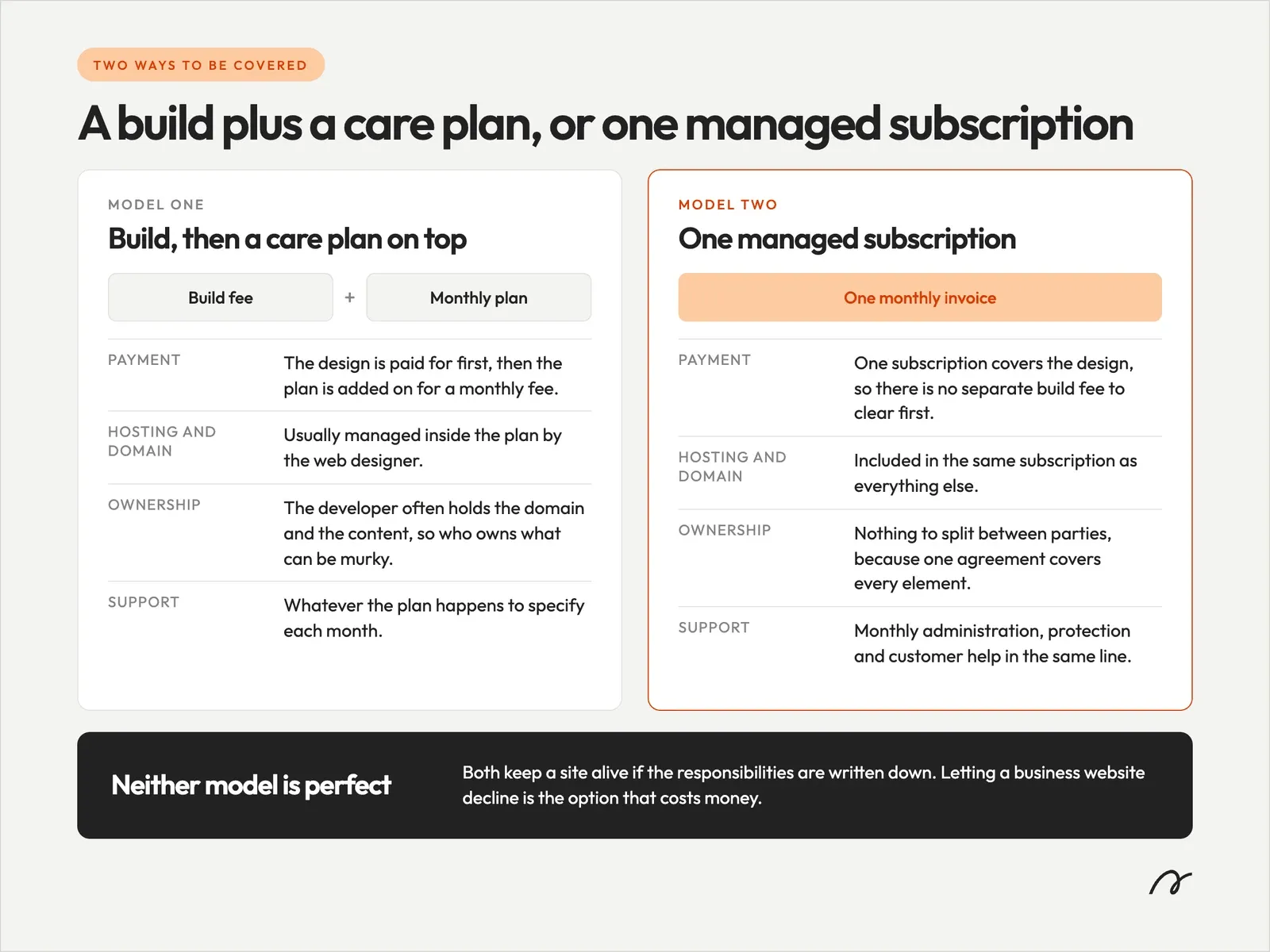
With a care plan, you pay once for the build and then monthly for upkeep, often to the same designer. With a managed website, the build, hosting, updates, security and support come in one subscription. The care is not an extra: it is part of the product.
| Website + care plan | Managed website | |
|---|---|---|
| How you pay | A build fee, then a monthly plan | One monthly subscription |
| Who does the upkeep | The designer or agency, within the limits of the plan | The platform, for every site at once |
| Invoices | Often several: hosting, domain, plan, extra changes | One |
| Ownership | Varies: the designer may hold the domain or the hosting | Set out in the subscription terms |
| Changes to content | A number of hours or requests per month | You edit it yourself or, depending on the plan, the team does it for you |
Neither model is wrong. A custom build with a care plan suits a business with unusual needs and a designer it trusts. A managed website suits a business that wants a predictable monthly price and nothing to maintain. What costs money in both cases is letting the site go stale.
Stride is a managed website: security patches, daily backups, the SSL certificate, uptime monitoring and the domain are handled for you, and you update the content yourself or, from the Business plan, the team does it for you. The plans are on the pricing page, and the Maker and Pro plans have no commitment. For the cost of each route in one industry, see how much a restaurant website costs.
What Should I Ask Before Signing a Website Care Plan?
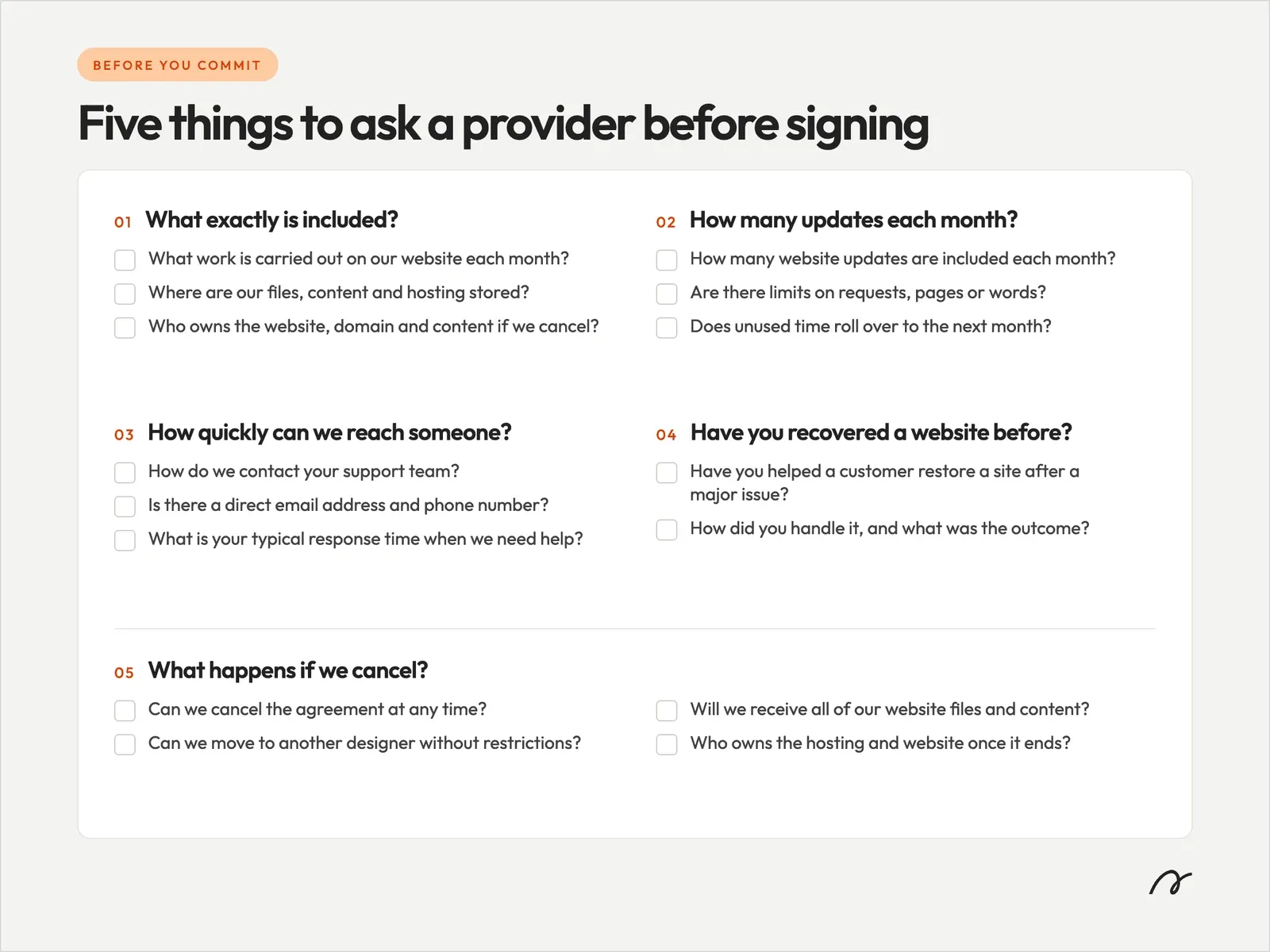
Before signing, ask five things: what is included, how many changes you get each month, how fast you can reach someone, whether the provider has ever restored a site, and what happens when you cancel. The answers tell you what you are buying and who is responsible for your website in the long run.
What Exactly Is Included?
- What work is done on our website each month?
- Where are our website files, content and hosting kept?
- Who owns the website, the domain and the content if we stop working with you?
How Many Changes Are Included Each Month?
- How many content changes are included each month?
- Are there limits on the number of requests, pages or words?
How Quickly Can We Reach Someone?
- How do we contact your support team?
- Do we get a direct email address and phone number?
- What is your usual response time?
Have You Restored a Website Before?
- Have you ever restored a customer’s website after a serious problem?
- How did you handle it, and how long did it take?
What Happens If We Cancel?
- Can we cancel at any time?
- Do we receive all our website files and content?
- Can we move to another provider without restrictions?
- Who holds the hosting and the domain once the agreement ends?
How Do I Know What My Website Needs Today?
The quickest way is to have your current online presence checked: how the site loads, what Google shows about your business, and what a customer finds when they look you up. That shows whether you need a care plan, a rebuild or only a few fixes.
Stride does this for free. Book an online presence analysis and we go through your website, your search visibility and your reviews with you.
Frequently Asked Questions
Is a website care plan the same as website maintenance?
Mostly, yes. Website care plan, website maintenance plan and website care package are names for the same kind of service. What changes from one provider to the next is the content of the plan, so compare what is included, not what it is called.
Is a website care plan worth it?
It is worth it when your website brings in bookings, orders or enquiries and nobody in the business has the time or the skills to keep it updated, backed up and secure. For a small page that never changes and that you can maintain yourself, it is not.
Do I need a care plan with a managed website?
No. On a managed website platform, hosting, security updates, backups, monitoring and support are part of the subscription. A separate care plan would pay for the same work twice.
Who owns my website if I cancel a care plan?
It depends on the contract, so ask before signing. You should keep your domain name and your content in every case. Ask the provider in writing what you receive when you leave and whether you can move to someone else.